

In research, bigger is not always better

In summary
Opinion for The Australian by Deputy Vice-Chancellor of Research, Professor Karen Hapgood.
Australia has a rich history of innovating for our climate, our community and our future. Our country’s researchers have developed critical technologies that change the world, from cochlear implants to the blackbox flight recorder, and the Gardasil HPV anticancer vaccine.
Despite a small and dispersed population, our ideas and R&D expertise have created a huge impact worldwide.
Publicly funded universities and research organisations like the CSIRO and ANSTO within the Australian research ecosystem have driven much of this. While the largest universities are most frequently mentioned, the truth is that the top researchers and field leaders are spread across institutions of all sizes across the country.
Younger universities like mine are not encumbered by long histories or large bureaucracies. The freedom to look for fresh opportunities without the need to maintain historical legacy research areas gives us the freedom to reinvent what university is about, and create a prototype of global best practice. Our size and agility keeps us laser focused on the needs of our industries and communities, adaptable to local and global changes and driven to make an impact in the areas that matter most.
By concentrating our efforts across six flagship initiatives – our north stars for research and development, innovation and commercialisation – we are maximising our leverage to create technology for purpose and co-create the industries of the future.
Take one of these flagships: Innovative Planet. With a focus on green energy and sustainable transport, we’re investing in developing cutting-edge solutions that can make a resilient future a reality.
That work is already driving technologies like wireless charging embedded directly into roads, unlocking the uptake of electric heavy vehicles. Or our efforts to develop carbon-neutral steelmaking, ensuring heavy industry plays its part in the energy transition, supported by a brand-new Green Steel Alliance.
But energy is a global problem, and it requires global solutions. No matter our size, we need to collaborate across borders, industries and universities. Only together can we train the people and build the technology that will create a better world.
It’s that spirit of collaboration that helped create the Franco-Australian Centre for Energy Transition (FACET), which is advancing co-operation on sustainable and inclusive energy initiatives in France, Australia and the Indo-Pacific.
This work goes beyond platitudes of international collaboration; it’s about investing in good ideas and good people, wherever they are in the world. By encouraging start-ups and spin-outs, we move beyond pure research to implement solutions and create jobs – even spawning entire new industries. Because change is not just made in the lab; it must be embedded in local communities around the world.
Take mDetect, a technology platform that uses particles from space called muons, to ‘see’ structures hidden underground for mining and construction companies. Through Swinburne Innovation Studio’s Elevate program, our interdisciplinary research team took the venture from exciting research to a full-scale commercial product that can make our infrastructure safer and massively reduce the risk of environmental disasters.
This isn’t a once off. Entromat, our latest start-up company, started from fundamental research on unusually complicated metal alloys and grew into advanced manufacturing of new powders. Their exceptional mechanical strength and resistance to corrosion, wear, and radiation makes them useful for aerospace, mining and medical technology.
In addition to global collaboration, research and commercialisation, our learning ecosystem must also transform to make real change. As a multisector university, we’re adapting to the needs of rapidly evolving and emerging industries, from vocational education to professional development.
This means supporting learners at every stage of their career to upskill and re-skill, ensuring research breakthroughs have the workforce to implement them.
For example, the state-of-the-art Swinburne Siemens Energy Transition Hub is bringing together students, industry partners and mid-career professionalsto create an integrated pipeline from education and research to solutions to workforce capability. All of this is possible thanks to our approach and position as a tech-focused, impact-driven institution.
This is the blueprint of a new and different university: agile, responsive and collaborative. We know it works overseas. Sheffield University in Britain is about the same size as my university and is home to the Advanced Manufacturing Research Centre, which is sought out by multinational companies as a hub of truly global innovation. Bold initiatives led by an Australian university with “only” 30,000 students are too often deemed too small to have critical mass, despite accolades for similar international initiatives and Australia’s unique history of defying this stereotype.
We are bringing that blueprint to Australia – working smarter, harder and together to make real change in the world. Guided by our recently launched strategy, Ad Astra_2030, we can solve wicked problems, build sovereign capability and boost productivity. The future is bright and Swinburne stands ready to forge Australia’s path towards it.
This article was originally published for The Australian.
-
Media Enquiries
Related articles
-

- Astronomy
- Technology
- Health
- Science
- University
- Sustainability
- Engineering
Swinburne highly cited researchers reach the top in 12 fields
Ten Swinburne academics have been named on the Highly Cited Researchers 2025 list, released by Clarivate
Tuesday 02 December 2025 -
- University
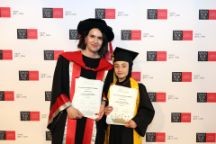
Over 550 students don caps and gowns to graduate from Children’s University Swinburne
Over 550 students from 34 schools have graduated from Children’s University Swinburne, celebrating over 45,000 hours of learning beyond the classroom this year.
Wednesday 03 December 2025 -

- Technology
- Health
- Science
- University
$1.2m ARC funding to boost national X-ray spectroscopy capability through Swinburne and QUT partnership
Swinburne has secured $1.2 million in the latest Australian Research Council Linkage Infrastructure, Equipment and Facilities scheme round
Tuesday 02 December 2025 -
- University
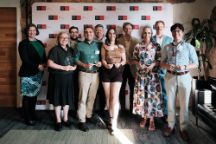
Swinburne researchers shine at the 2025 Media and External Communications Recognition Awards
Swinburne’s 2025 Media and External Communications Recognition Awards have recognised our academics for notable media and social media outreach.
Thursday 04 December 2025 -

- University
Update on Union Street Windsor
An update from Swinburne University of Technology on the property at 131–133 Union Street, Windsor.
Friday 07 November 2025


